
In Senetářov, in the Drahany Highlands not far from Jedovnice, stands one of the few churches built in Czechoslovakia under communism. It went up between 1969 and 1971, fulfilling a vow the villagers made in 1944 before being forcibly evicted from their homes. It was designed by the painter Ludvík Kolek after Le Corbusier’s chapel at Ronchamp. The roof, a shell that sweeps upwards, resembles the hull of a ship. Inside you will find a blue altar triptych by Kolek and the Stations of the Cross by Mikuláš Medek. Believers gave more than 30,000 hours of unpaid labour to the build, and the state contributed nothing. The church was not consecrated until 1991. Entry is free (0 Kč), and it is generally open during services.
QUICK LINKS 🙏 The vow of 1944 · 🏗️ Building under “normalisation” · ⛵ A ship of concrete and glass · 🎨 Kolek and Medek · 🚗 Visiting · ❓ FAQ
Senetářov is the village where I grew up. If you drive the road from Blansko to Vyškov, you will see a curious grey building with a sloping roof rising like a bow in the middle of the village. Few people have any idea of the story behind it.
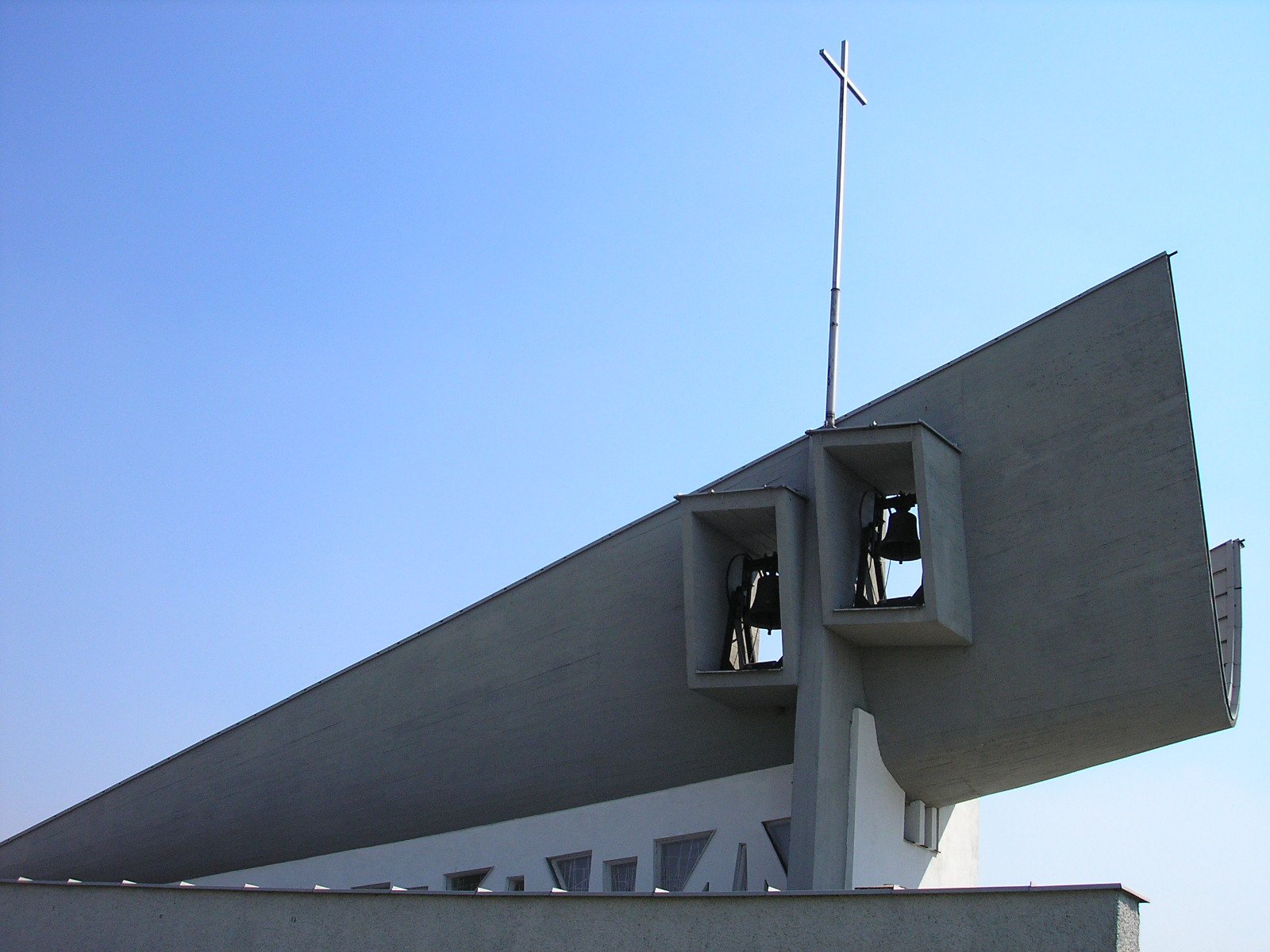 The ship-shaped roof with its bell towers. Photo: Josef Kopřiva
The vow of 1944
From 1855, a small chapel dedicated to St Joseph stood in the middle of the village green. St Joseph had always belonged to the village: his emblem, the lily, appears on the oldest municipal seal.
In 1944, most of Senetářov’s inhabitants were forced to leave their homes, as the village was to be used as a German firing range. Before they left, people gathered to pray in the old chapel. Together with them, the Jedovnice chaplain Josef Zouhar and the future dean František Vavříček spoke a vow: if they returned home safely, they would build a new chapel. The whole packed chapel repeated the words.
The villagers did come back, but they had to wait more than 20 years to keep their promise.
Building under “normalisation”
The opportunity came in the spring of 1968. František Vavříček, by then dean of Jedovnice, had just completed a bold modernisation of the parish church in Jedovnice and decided that Senetářov should have a new church. He was in a hurry, and he was right to be: in August the Soviet tanks rolled in. By then, however, the plans and the money were already in place. It also helped that the old chapel stood in the way of widening the Blansko–Vyškov road.
The foundation stone was laid on 29 June 1969, when the period of “normalisation” was already under way. The authorities and the local Communist Party organisations watched the construction closely.
- The state did not contribute a single crown. The money came from local people and from donors abroad.
- The design, the project and the building work were all unpaid. The engineering was handled by Otakar Vrabec.
- Believers from Senetářov and the surrounding area worked more than 30,000 hours without pay. Master carpenter Karel Skoták from Suchdol, who built the formwork for the complex reinforced-concrete structures, commuted daily and led the main works for free.
The first Mass in the new church was held on 11 July 1971. The authorities allowed it to be used only on condition that it would not be ceremonially consecrated, so the Bishop of Brno, Karel Skoupý, was not permitted to attend. The church had to wait until 7 July 1991 for its consecration, when Bishop Vojtěch Cikrle also blessed the new organ.
A film from the time shows how the building work progressed:
You can find more videos from Senetářov in the Senetářov playlist on my YouTube channel.
A ship of concrete and glass
Ludvík Kolek was not a trained architect but a painter. He therefore modelled the church more like a sculptor: first he conceived the spatial mass of the building, and only then the ground plan. His inspiration was Le Corbusier’s chapel of Notre-Dame-du-Haut at Ronchamp, one of the most famous buildings of the 20th century. The Senetářov church, however, is no copy.
What you will see from the outside:
- The roof is a reinforced-concrete shell in the form of a hyperbolic paraboloid. It rises and narrows towards the altar. It is meant to evoke a ship as a symbol of the Church, carrying the faithful through life to God.
- Set into the highest point of the roof are 2 concrete bell towers with bells, and above them a tall cross.
- The façade consists of 5 vertical strip windows. The main entrance is not in the centre but on either side of a glass portal.
- To the sides project the rounded baptistery and a side chapel, with irregularly scattered windows of cast glass. Each window depicts one of the 7 sacraments.
Inside, the space narrows towards the altar and gradually grows brighter. The stained glass in the ceiling moves from dark colours to light ones and, according to its creator, represents the creation of light.
Kolek and Medek: art that was not welcome at the time
The church is part of the so-called Jedovnice trilogy. In the 1960s and 70s, modern art met the Church in this single parish, which was far from usual at the time. Besides Senetářov, the trilogy comprises the remodelling of the interior of the parish church in Jedovnice (1962–1963) and the chapel in Kotvrdovice.
- The altar triptych by Ludvík Kolek consists of 3 blue paintings arranged in the shape of a cross: Creation, Redemption (the Last Supper seen from above) and Sanctification with the dove. The third painting is deliberately smaller and disturbs the balance of the cross, a reminder that the work of the Holy Spirit is not yet complete. Kolek also designed the altar, the ambo, the font and the stained glass.
- The Stations of the Cross by Mikuláš Medek (1970) does not have the usual 14 separate stations but forms a single continuous band on the left-hand wall. Medek, a grandson of the painter Antonín Slavíček, worked mainly in red, blue and gold, and instead of figures he painted symbols: the crown of thorns, the cross, Veronica’s veil, dice, nails.
- The Madonna and Child is a copy of the Gothic Madonna of Ruskinovce from around 1300. It was made in 1984 by the restorer František Sysel. From the same year dates the bronze relief of St Joseph by Kolek.
- In front of the church stands the original stone statue of St Joseph from 1800, which once adorned the old chapel.
Visiting
- Where: Senetářov 116, in the centre of the village by the Blansko–Vyškov road, about 11 km east of Blansko. In front of the church is a small pond with water lilies.
- Entry: free.
- When: the church is a branch church belonging to the parish of Jedovnice, so it is generally open during services. Check current times on the village website, senetarov.cz, or with the municipal office (tel. 516 442 424). You can view it from the outside at any time.
- In the village you will also find the Museum of Traditional Housing and Mother-of-Pearl Crafts, a reminder that Senetářov was long a centre for making mother-of-pearl buttons.
- Combine it with a day out: Jedovnice is a few kilometres away, and from there you can continue to the Rudice Sinkhole. To the north lie the Bílá voda nature reserve and the Sloup-Šošůvka Caves (Sloupsko-šošůvské jeskyně).
FAQ
Who designed the church in Senetářov? The painter Ludvík Kolek; the engineering was handled by Otakar Vrabec. The Stations of the Cross was painted by Mikuláš Medek.
When was the church built? Between 1969 and 1971. The first Mass was held on 11 July 1971, and it was consecrated only on 7 July 1991.
Why does the church look like a ship? The roof is a shell in the form of a hyperbolic paraboloid, rising towards the altar. The ship is a symbol of the Church carrying the faithful to God. Kolek drew inspiration from Le Corbusier’s chapel at Ronchamp.
Can you visit the church? Yes, entry is free. It is generally open during services; you can find current times from the municipal office or on the village website.
Part of the series Hidden Stories of the Moravian Karst. More from my home village: Place Names and Legends of Senetářov. What else to see in the village and where to stay: Senetářov. Information verified as of 9. 10. 2026. Sources: Švecová, A.: Kostel sv. Josefa v Senetářově, bachelor’s thesis, Faculty of Arts, Masaryk University, Brno 2006 (supervisor PhDr. Aleš Filip, Ph.D.); Zukal, A.: Historie Senetářova (1994, expanded edition in cooperation with the Municipality of Senetářov 1999); Hartmann, A.: Jedovnice – Kotvrdovice – Senetářov, Umění a řemeslo 1994, no. 3; brochure of the DSO Moravský kras, profile of the municipality of Senetářov; Kostel svatého Josefa (Senetářov), Wikipedia; Kudy z nudy: Moderní kostel sv. Josefa v Senetářově.
Spotted a mistake or an out-of-date detail? Tell us.
Complete 7-day itinerary — free
Get a detailed week-long plan sent to you: caves, Macocha, day trips, where to stay. The PDF arrives by email right away.